
Constructed Wetlands: Addressing Punjab's Rural Challenges
Explore how constructed wetlands in Punjab tackle multiple rural challenges by treating sewage at the source, protecting groundwater, recharging aquifers, and restoring ecosystems. Grounded in research and success from institutions like the University of Agriculture Faisalabad.
SPOTLIGHT
Muhammad Khalid Bashir
1/9/2026
Punjab’s rural water crisis is not solely a matter of declining availability; it is equally, if not more critically, a crisis of deteriorating water quality. Across thousands of villages, shallow aquifers, once considered safe sources of drinking and domestic water, are increasingly contaminated by untreated sewage, agricultural runoff, and poorly designed sanitation systems. The widespread reliance on septic tanks and soak pits, often constructed without proper lining or hydrogeological assessment, has resulted in chronic leakage of pathogens, nutrients, and organic pollutants into groundwater. This contamination directly threatens public health, undermines rural livelihoods, and accelerates ecological degradation.
In this context, constructed wetlands (CWs) present a compelling, nature-based solution that aligns sanitation, groundwater recharge, and ecosystem restoration into a single, integrated framework. Constructed wetlands are engineered systems designed to mimic the purification processes of natural wetlands, using vegetation, soil, and microbial communities to treat wastewater efficiently and at low cost. Unlike conventional mechanical wastewater treatment plants, CWs require minimal energy input, low operational expertise, and can be managed at community level making them particularly suitable for rural Pakistan.
Globally, constructed wetlands are recognized as sustainable wastewater treatment systems capable of removing organic matter, nutrients, pathogens, and even heavy metals. Studies across Asia, Africa, and Europe show that properly designed wetlands can reduce biochemical oxygen demand (BOD) by 70–90 percent, chemical oxygen demand (COD) by 60–85 percent, total suspended solids (TSS) by over 80 percent, and fecal coliforms by several orders of magnitude. These outcomes position constructed wetlands as effective pre-treatment or full-treatment systems for wastewater reuse and aquifer recharge.
Existing Research and Institutional Experience in Pakistan
Importantly, constructed wetland research is not a novel or untested concept in Pakistan. Substantial academic and applied research has already been conducted by leading national institutions. At Quaid-i-Azam University (QAU), Islamabad, a full-scale constructed wetland was developed under the Small-Scale Sewage Treatment and Wastewater Reuse System for Pakistan project. The system successfully treated residential wastewater to levels suitable for irrigation, demonstrating the technical feasibility of decentralized wetland-based sanitation in the Pakistani context.
Similarly, the University of Agriculture, Faisalabad (UAF) has undertaken extensive experimental research on vertical-flow and hybrid constructed wetlands using indigenous macrophytes such as Typha latifolia and Canna indica. Controlled studies at UAF reported heavy metal removal efficiencies exceeding 90 percent for chromium and substantial reductions in BOD, COD, and nutrients, highlighting the capacity of wetlands to treat even industrially influenced effluents before safe discharge or recharge.
At the Ayub Agricultural Research Institute (AARI), Faisalabad, applied environmental research has increasingly focused on water quality, nutrient management, and nature-based solutions for sustainable agriculture. In parallel, studies at MNS-University of Agriculture Multan indicate that surface-flow constructed wetlands achieved reductions of more than 75 percent in BOD and TSS, reinforcing the adaptability of wetland systems across different agro-climatic zones of Punjab.
These research efforts collectively demonstrate that Pakistan already possesses the scientific knowledge and institutional capacity required to scale constructed wetlands for rural sanitation and groundwater protection.
Reimagining Village Chappars as Constructed Wetlands
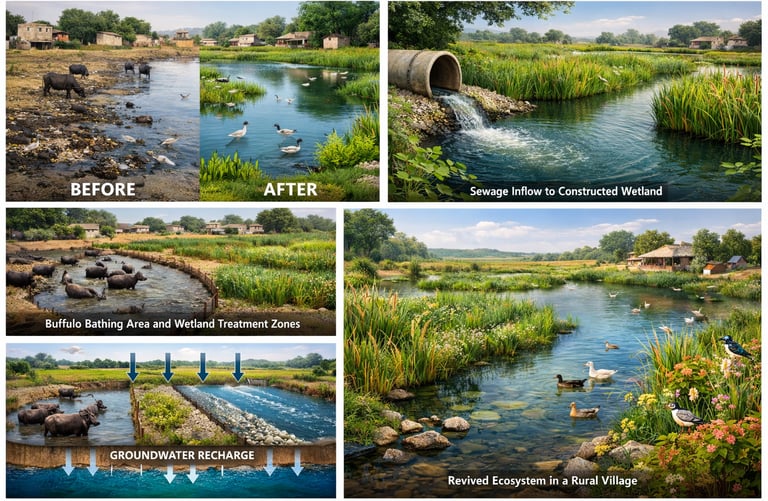
Punjab’s villages traditionally contain communal water bodies, locally known as chappars or cholera ponds, used for buffalo bathing, stormwater storage, and livestock watering. Over time, many of these chappars have become highly polluted due to the inflow of untreated domestic wastewater and solid waste dumping. Rather than viewing these water bodies as environmental liabilities, they can be re-envisioned as the structural foundation for constructed wetlands.
Under this model, village sewage and greywater would be diverted away from households and shallow soak pits into reconstructed chappars designed as multi-stage wetland treatment systems. The first stage would function as a sedimentation basin, allowing solids and grit to settle. Subsequent treatment zones would be planted with wetland vegetation such as Typha, Phragmites, Canna, and lotus, which support microbial biofilms responsible for degrading organic matter and nutrients. In the final stage, treated water would percolate through vegetated soil columns or infiltration beds, facilitating managed aquifer recharge with significantly improved water quality.
To address cultural and practical needs, buffalo bathing areas can be physically separated from treatment zones, ensuring both hygienic safety and community acceptance. This spatial zoning preserves traditional livestock practices while preventing recontamination of treated water.
Environmental and Public Health Benefits
The environmental and health gains from such systems are substantial. By intercepting sewage before it reaches aquifers, constructed wetlands reduce the prevalence of waterborne diseases such as diarrhea, typhoid, hepatitis, and parasitic infections, conditions that disproportionately affect children and women in rural areas. Lower BOD and pathogen levels mean that groundwater drawn from nearby hand pumps and wells becomes safer for domestic use, reducing healthcare costs and productivity losses.
From an ecological perspective, constructed wetlands restore local biodiversity by providing habitat for birds, amphibians, pollinators, and aquatic organisms. Evidence from wetland projects in South Asia shows rapid recolonization by native species once water quality improves. Vegetation in wetlands also contributes to carbon sequestration, moderates local temperatures, and reduces dust, offering microclimatic benefits in heat-stressed rural environments.
Hydrologically, the controlled recharge of treated water helps counteract over-extraction of groundwater, a major concern in Punjab where falling water tables have increased pumping costs and energy demand. By augmenting recharge with cleaner water, constructed wetlands support long-term aquifer sustainability rather than merely slowing depletion.
Economic and Governance Advantages
Compared to conventional sewage treatment plants, constructed wetlands are significantly cheaper to build and operate. They rely on locally available materials, require minimal electricity, and can be maintained through community-based management systems. Village water committees or farmer organizations can oversee routine maintenance, such as vegetation management and desilting, ensuring long-term functionality.
From a policy perspective, integrating constructed wetlands into rural sanitation planning offers a cost-effective alternative to widespread septic tank construction, which has proven environmentally unsustainable. Aligning wetland development with existing groundwater recharge, climate adaptation, and rural development programs can further enhance cost efficiency and institutional coherence.
Conclusion
Constructed wetlands offer Punjab a rare opportunity to address multiple rural challenges through a single, integrated intervention. By treating sewage at source, protecting groundwater from contamination, recharging depleted aquifers, and restoring local ecosystems, these systems redefine sanitation as an environmental and water-security asset rather than a waste-management burden. The concept is not theoretical; it is grounded in credible research and demonstrated success at institutions such as the University of Agriculture Faisalabad, Ayub Agricultural Research Institute, and Quaid-i-Azam University Islamabad.
Repurposing village chappars into constructed wetlands is particularly compelling because it builds on existing infrastructure, cultural practices, and communal land arrangements. This approach avoids the long-term environmental costs of septic tanks while delivering tangible public health, ecological, and economic benefits. Cleaner drinking water, reduced disease burden, enhanced biodiversity, and improved groundwater recharge collectively strengthen rural resilience in the face of climate change and water scarcity.
For policymakers, the priority should be mainstreaming constructed wetlands into rural sanitation and water policies, supported by technical guidelines, pilot projects, and institutional coordination. With modest investment and strong community engagement, constructed wetlands can become a cornerstone of sustainable rural development in Punjab, restoring ecosystems, safeguarding public health, and securing groundwater resources for future generations.
Please note that the views expressed in this article are of the author and do not necessarily reflect the views or policies of any organization.
The writer is affiliated with the Institute of Agricultural and Resource Economics, University of Agriculture, Faisalabad Pakistan and can be reached at khalid450@uaf.edu.pk




Related Stories
📬 Stay Connected
Subscribe to our newsletter to receive research updates, publication calls, and ambassador spotlights directly in your inbox.
🔒 We respect your privacy.
🧭 About Us
The Agricultural Economist is your weekly guide to the latest trends, research, and insights in food systems, climate resilience, rural transformation, and agri-policy.
🖋 Published by The AgEcon Frontiers (sPvt) Ltd. (TAEF) a knowledge-driven platform dedicated to advancing research, policy, and innovation in agricultural economics, food systems, environmental sustainability, and rural transformation. We connect scholars, practitioners, and policymakers to foster inclusive, evidence-based solutions for a resilient future.
The Agricultural Economist © 2024
All rights of 'The Agricultural Economist' are reserved with TAEF